Many beginners spend their early sessions thinking mostly about how to hit the ball. But in padel, where you stand and how you move often matter more than your technique. A well-positioned pair with modest shots will usually beat two strong hitters who are constantly out of position.
The good news is that positioning is very learnable. Once you understand the basic roles, when to attack, when to defend, and how to move with your partner, the game becomes far less chaotic and much more enjoyable. This guide covers the essentials.
Why positioning matters more than power
Padel is a game of control. The team that holds the net usually dictates the point, forcing opponents into defensive positions and waiting for a mistake or an opening. If you are constantly caught in the wrong place, even good shots become difficult to execute.
Understanding position gives you time, options, and confidence. It lets you reach more balls comfortably and reduces the rushed, off-balance shots that lead to easy errors.
The two basic positions
At any moment, your pair is generally in one of two states:
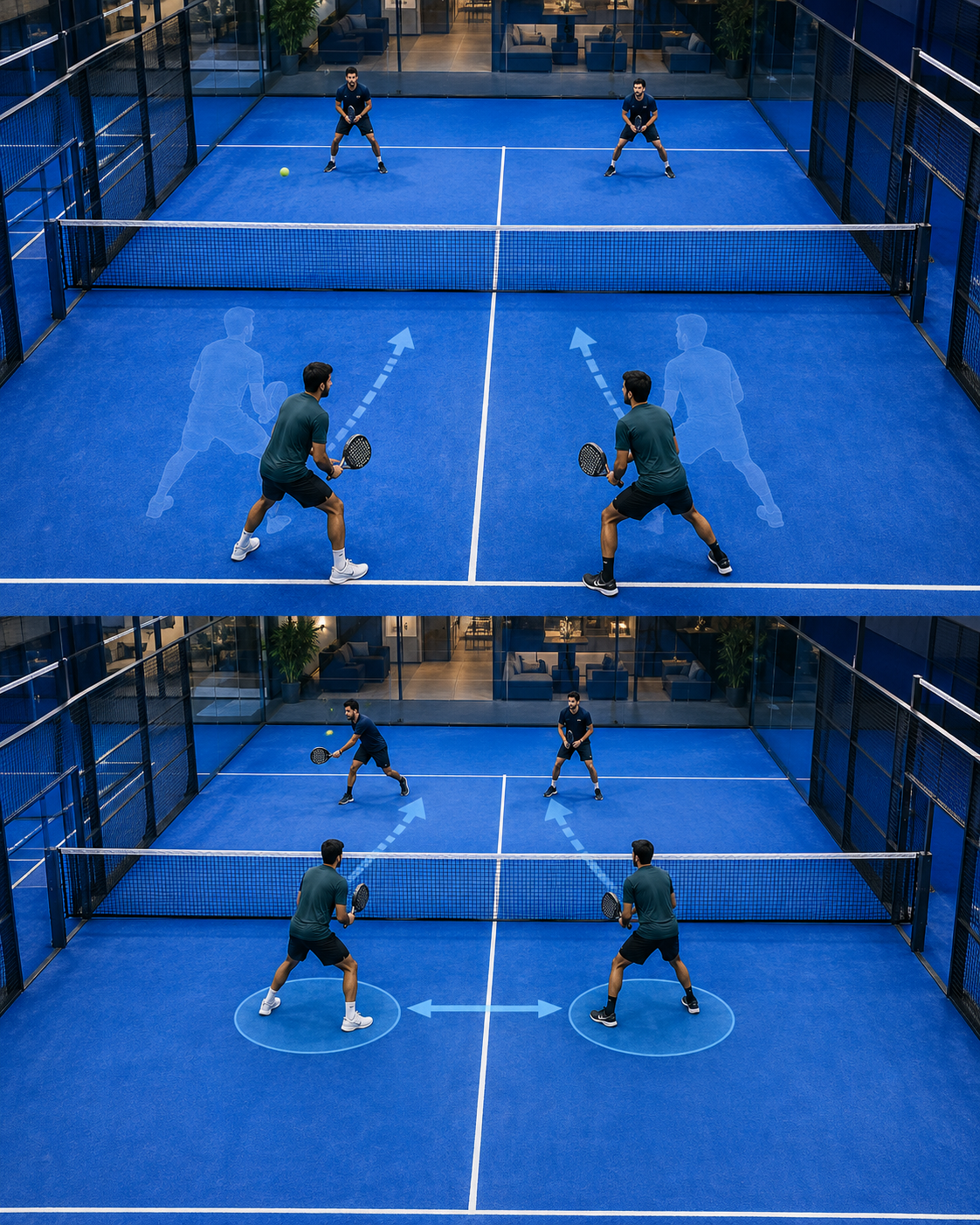
- Attacking at the net — Both players stand near the net, ready to volley and apply pressure. This is the position you want to reach and hold whenever possible.
- Defending at the back — Both players stay back near their own glass, absorbing pressure, using the walls, and looking to lob their way back into control.
The important idea is that both players should usually be in the same state. You attack together or defend together, rather than one player up and one player back.
Move as a pair, not as two individuals
The single most useful positioning habit is to imagine an invisible rope connecting you and your partner. When one of you moves left, the other shifts left too. When one moves forward, the other follows. This keeps your shape intact and prevents large gaps from opening up between you.
New players often chase the ball individually and leave huge spaces behind them. Moving as a connected pair closes those gaps and makes your side of the court much harder to break down.
When to move up to the net
The net is the most powerful position in padel, but you have to earn it. The safest time to move forward is after you have played a good lob or a deep, controlled shot that pushes your opponents back and gives you time to advance together.
Avoid rushing to the net off a weak shot. If you move up after a short ball, skilled opponents will simply lob you or drive the ball past you. Move forward with purpose, and move as a pair.
When to drop back and defend
If your opponents lob you successfully or take control of the net, do not panic. Drop back toward your own glass, give yourself room, and use the walls to buy time. Defending well is a skill in itself, and patient defense often earns you the chance to lob and reset the point.
The goal while defending is not to hit a spectacular winner. It is to stay in the rally, keep the ball in play, and wait for the moment to lob your way back into an attacking position.
Covering the middle
A large number of padel points are won or lost through the middle of the court. As a pair, you should be aware of who takes balls down the center, usually the player whose forehand is in the middle. Communicating about the middle prevents the classic beginner situation where both players leave it, assuming the other will take it.
Left side and right side roles
In doubles, each player typically covers one side of the court. The right-side player often handles more balls in the middle and is frequently the steadier, more defensive partner, while the left-side player tends to take on more of the aggressive, overhead-oriented play. As a beginner you do not need to overthink this, but it helps to agree on sides and understand your general responsibilities.
Common positioning mistakes
- Splitting up — Having one player at the net and one at the back leaves big gaps and is easy to exploit.
- Rushing the net too early — Moving forward off a weak shot usually results in being lobbed or passed.
- Standing too flat against the back wall — Give yourself room so the ball can rebound off the glass and you can play it comfortably.
- Leaving the middle — Assuming your partner will cover the center is a common way to concede easy points.
Habits that improve your positioning
- Talk to your partner — Simple calls like “mine,” “yours,” and “back” keep you organized.
- Reset together — After every shot, glance at where your partner is and adjust as a pair.
- Watch better players — Notice how experienced pairs move together and hold their shape.
- Prioritize the lob — Use it to earn the net rather than forcing risky drives.
Final thoughts
Positioning is one of the fastest ways to improve in padel, and it costs you nothing in terms of technique. Move as a pair, attack the net when you have earned it, defend patiently when you must, and stay aware of the middle.
Get these habits right and you will find yourself in control of far more points, even before your shots become polished. In padel, being in the right place is often half the battle.
Frequently asked questions
Where should beginners stand in padel?
As a pair you should generally be together, either both at the net attacking or both at the back defending, rather than one player up and one player back.
When should I move to the net in padel?
Move forward after a good lob or a deep, controlled shot that pushes your opponents back and gives you and your partner time to advance together.
Why do my partner and I keep leaving gaps?
Usually because you are moving independently. Imagine a rope connecting you and shift together so the space between you stays small.